
Prečica Lycopodium clavatum (Lycopodiaceae)
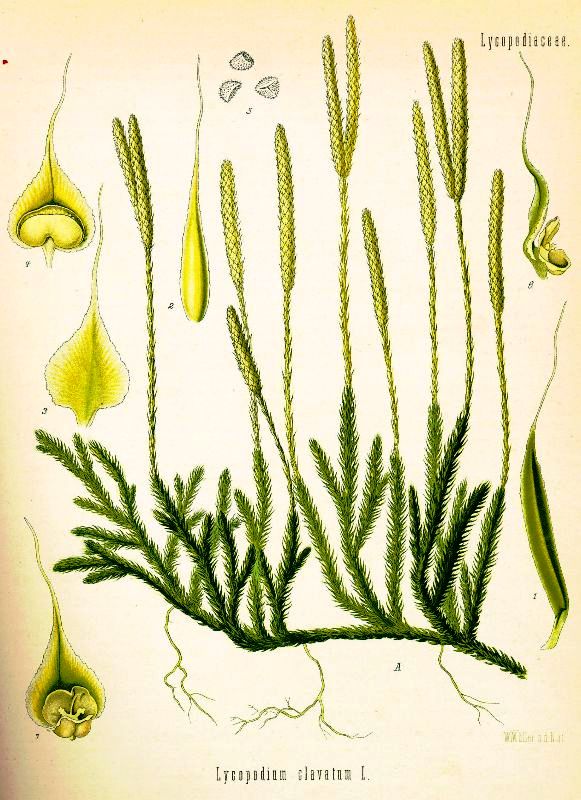
LYCOPODIUM CLAVATUM POUR PRÉPARATIONS HOMÉOPATHIQUES
Lycopodium clavatum (Lycopodiaceae)
Common names: Clubmoss; Antler Herb
How used: Medicinal
Activities: 384 Chemicals w/Activities: 30 Chemicals: 103
Antioxidant, Cancer-Preventive, Antiinflammatory, Pesticide, Diuretic, Hypocholesterolemic, Antiarthritic, Antispasmodic, Vasodilator, Antileukemic, Antitumor, Choleretic, Antiarrhythmic, Anxiolytic, Antimutagenic, Antiosteoporotic, Antibacterial, Hypotensive, Antiviral, Aldose-Reductase-Inhibitor, Antialopecic, Antiaggregant, Insectifuge, Antidiabetic, Antiestrogenic, AntiHIV, Analgesic, Antidepressant, Antiallergic, Cytotoxic, Immunomodulator, Antitumor (Skin), Antihypertensive, Antihistaminic, Antifatigue, Hepatoprotective, Antiherpetic, Antiseptic, Anticoronary, Antiradicular, Laxative, Antiproliferant, Antiepileptic, Sunscreen, Antiacne, Immunostimulant, Fungicide, Ornithine-Decarboxylase-Inhibitor, AntiPMS, NF-kB-Inhibitor, Antiencephalopathic, Xanthine-Oxidase-Inhibitor, Antitumor-Promoter, Antianemic, Antisyndrome-X, Myorelaxant, Antimelanomic, FLavor, Hypercholesterolemic, 5-Alpha-Reductase-Inhibitor, Antiangiogenic, Tranquilizer, Calcium-Antagonist, Nematicide, Antistress, Propecic, Vulnerary, Anticomplementary, Cardioprotective, Antiandrogenic, Antiinsomniac, Antialcoholic, Anticarcinogenic, Hepatotropic, Lubricant, Differentiator, Antifibrinolytic, Deiodinase-Inhibitor, Anticataract, Beta-Glucuronidase-Inhibitor, ….
Reference:
Wichtl, M. 1984. Teedrogen. Ein Handbuch fur Apotheker und Arzte. Wissenschaftliche Verlagsgesellscharft. mbH Stuttgart. 393 pp.
Ki Soon Rhee. Oilseed Food Ingredients Used To Minimize Oxidative Flavor Deterioration in Meat Products. Phenolic Compounds in Food and Their Effects on Health, Ch.18.
Recio, M. C., Rios, J. L., and Villar, A., A review of some antimicrobial compounds isolated from medicinal plants reported in the literature 1978-1988, Phytotherapy Research, 3(4), 1989, 117-125.
Challem, J., Berkson, Burt, and Smith, Melissa Dianne. 2000. Syndrome X – The complete nutritional program to prevent and reservse insulin resistance. John Wiley & Sons, New York. 272 pp. $24.95
Davies, S., and Stewart, A. 1990. Nutritional Medicine. Avon Books, New York. 509pp.
Tunon, H., Thorsell, W., and Bohlin, L. 1993. Mosquito Repelling Activity of Compounds Occurring in Achillea millefolium L. (Asteraceae). Economic Botany 48(2): 111-120, 1994.
Economic & Medicinal Plant Research, 6: 189.
Werbach, M. 1993. Healing with Food. Harper Collins, New York, 443 pp.
Ohnishi, M., Morishita, H., Iwahashi, H., Toda, S., Shirataki, Y., Kimura, M., and Kido, R. 1993. Inhibitory Effects of Chlorogenic Acids on Linoleic Acid Peroxidation and Haemolysis. Phytochemistry. 36(3): 579-583. 1994.
=ICMR(Indian Council of Medical Research).1976.Medicinal Plants of India.Vol.1.Indian Council of Med. Res.Cambridge Printing Works, New Delhi.487 pp;ICMR.1987.Medicinal Plants of India.Vol.2.Indian Council of Med. Res.Cambr. Printing Works,New Delhi.600pp
Werbach, M. 1993. Healing with Food. Harper Collins, New York, 443 pp.
Martindale’s 29th
Cancer Research, 48: 5941.
Chiang, L. C., Chiang, W., Chang, M. Y., Ng, L. T., Lin, C. C. 2003. Antileukemic activity of selected natural products in Taiwan. Am J Chin Med, 31(1):37-46.
Aloe Research Council – Duke writeup of non-peer reviewd book by Coats and draft by Henry
Spiller, G. A. 1996 (Spiller, G. A. Ed. 1996. CRC Handbook of Lipids in Human Nutrition. CRC Press. Boca Raton, FL. 233 pp.)
Nigg, H.N. and Seigler, D.S., eds. 1992. Phytochemical Resources for Medicine and Agriculture. Plenum Press, New York. 445 pp.
Davies, S., and Stewart, A. 1990. Nutritional Medicine. Avon Books, New York. 509pp.
Forest H. Nielsen, USDA, Grand Forks, various publications.
Jeffery B. Harborne and H. Baxter, eds. 1983. Phytochemical Dictionary. A Handbook of Bioactive Compounds from Plants. Taylor & Frost, London. 791 pp.
Economic & Medicinal Plant Research, 1: 53.
Jim Duke’s personal files.
Shin*, K.H., Chung, M.S., Chae, Y.J., Yoon, K.Y., Cho, T.S. 1992. A survey for aldose reductase inhibition of herbal medicines. Fitoterapia 64(2): 130, 1993.
Info: Dr. Dzejms A. Djuk (Dr. James A. Duke)
LYCOPODIUM CLAVATUM POUR PRÉPARATIONS HOMÉOPATHIQUES
Pharmacopée française 1989
SOUCHE
La teinture mère de Lycopodium clavatum est préparée à la teneur en éthanol de 90 pour cent V/V, à partir des spores séchées de Lycopodium clavatum L., selon la technique générale de préparation des teintures mères (voir la monographie Préparations homéopathiques (1038) et la Précision complémentaire de l’Autorité française de Pharmacopée).
ESSAI
Éthanol (2.9.10) : 85 pour cent V/V à 95 pour cent V/V.
Résidu sec (2.8.16) : au minimum 0,50 pour cent m/m.