
LANILIST – Linaria vulgaris Mill. (Scrophulariaceae)
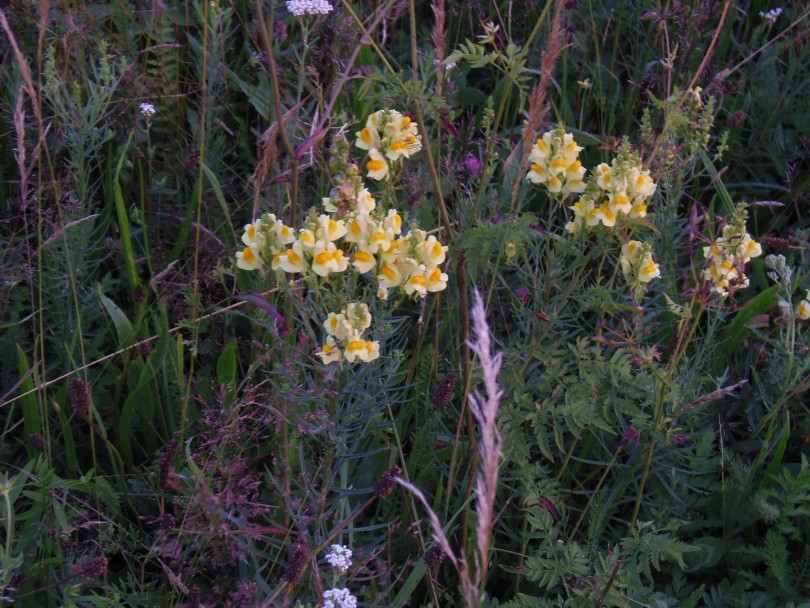
LANILIST – Linaria vulgaris Mill. (Scrophulariaceae)
Dr. Duke Common names: Butter And Eggs; Linnete; Leinkraut; Nevruzotu; Hosoba-Unran
Uses:Cancer, Diuretic, Jaundice,Laxative, Liver, Astringent, Emollient, Hepatitis, Litholytic, Liver, Piles, Scrofula, Scurvy, Splenitis, Vulnerary,
Reference: Hartwell, J.L. 1967-71. Plants used against cancer. A survey. Lloydia 30-34.
Steinmetz, E.F. 1957. codex Vegetabilis. Published by the author, Amsterdam.
Uphof, J.C. Th. 1968. Dictionary of economic plants. 2nd ed. Verlag von J. Cramer.
ANON. 1978. List of Plants. Kyoto Herbal Garden, Parmacognostic Research Lab., Central Research Division, Takeda Chem. Industries, Ltd., Ichijoji, Sakyoku, Kyoto, Japan.
Uphof, J.C. Th. 1968. Dictionary of economic plants. 2nd ed. Verlag von J. Cramer.
PFAF Antiphlogistic; Astringent; Cathartic; Detergent; Diuretic; Hepatic; Homeopathy; Ophthalmic; Purgative.
Yellow toadflax has a long history of herbal use. It acts mainly on the liver and was once widely employed as a diuretic in the treatment of oedema. It is little used now, but undoubtedly merits investigation. The whole plant is antiphlogistic, astringent, cathartic, detergent, depurative, diuretic, hepatic, ophthalmic and purgative. It is gathered when just coming into flower and can be used fresh or dried. The plant is especially valued for its strongly laxative and diuretic activities. It is employed internally in the treatment of oedema, jaundice, liver diseases, gall bladder complaints and skin problems. Externally it is applied to haemorrhoids, skin eruptions, sores and malignant ulcers. The plant should be used with caution. It should preferably only be prescribed by a qualified practitioner and should not be given to pregnant women. Dosage is critical, the plant might be slightly toxic. The fresh plant, or an ointment made from the flowers, is applied to piles, skin eruptions etc. The juice of the plant, or the distilled water, is a good remedy for inflamed eyes and cleaning ulcerous sores. A homeopathic remedy is made from the plant[9]. It is used in the treatment of diarrhoea and cystitis.
Despite its reputation as a weed, like the dandelion, this plant has also been used in folk medicine for a variety of ailments. A tea made from the leaves was taken as a laxative and strong diuretic as well as for jaundice, dropsy, and enteritis with drowsiness.[citation needed] For skin diseases and piles, either a leaf tea or an ointment made from the flowers was used.[citation needed] In addition, a tea made in milk instead of water has been used as an insecticide. It is confirmed to have diuretic and fever-reducing properties.
Linaria species have been investigated mostly because of their medicinal properties, and the available literature on its phenolic constituents has been reviewed recently by Cheriet et al. (2015). It has been reported that L. vulgaris contains luteolin, diosmetin, hispidulin , quercetin, acacetin and pectolinaringenin glycosides as well as chrysin, acetylpectolinarin and iridoid glycosides (Cheriet et al. 2015; Hua et al. 2004; Otsuka 1992; Valdés 1970; Vrchovská et al. 2008). Our analysis showed that additionally L. vulgaris contained apigenin, isorhamnetin and naringenin glycosides, and hesperetin (Tables 1, 2). …
YELLOW TOADFLAX WebMD
Linaria vulgaris (common toadflax) CABI
Linaria vulgaris Yellow Toadflax Practical Plants
Chemical constituents and biological activities of the genus Linaria (Scrophulariaceae)
TEINTURE MÈRE LINARIA VULGARIS
Indications :
La teinture mère Linaria vulgaris des laboratoires HA est un médicament homéopathique traditionnellement utilisé dans le traitement des éructations, des nausées, des douleur stomacale, des ictères, des hypertrophies hépatiques, des symptômes entériques accompagnés d’une grande somnolence, des douleurs rectales.
Règles sur la posologie:
Dans l’ensemble des cas, les recommandations oscillent entre 50 et 150 gouttes par jour selon les personnes et la gravité des troubles.
Étant donné qu’il s’agit ici de doses pondérales, il est évident qu’une règle de proportionnalité doit être appliquée en fonction du poids de la personne.
En pratique, il convient de commencer avec des dosages relativement faibles afin de na pas déclencher des débâcles éliminatoires difficiles à gérer, et de monter ensuite progressivement le nombre de gouttes jusqu’à obtention de résultats tangibles et satisfaisants.
En outre, il est d’usage de répartir les posologies journalières sur 3 prises.
Soit une formulation:
0,75 x le poids = Y (Y étant le nombre de gouttes à prendre par jour).
Y 3 = Z (Z étant la répartition des prises journalière 3 fois par jour).
Posologie usuelle:
Adultes 10 à 15 gouttes par prise 2 à 3 fois par jour.
Enfants de moins de 12 ans 1 goutte par année d’âge, ne pas dépasser 10 gouttes par prise et ce 3 fois par jour.
Ces posologies sont données à titre indicatif et peuvent varier selon le contexte clinique.
Médicament réservé à l’adulte et sur avis médical pour les enfants.
Attention ce médicament contient au maximum 51% V/V d’éthanol (alcool). Son utilisation est dangereuse chez les sujets alcooliques et doit être prise en compte chez les femmes enceintes ou allaitant, les enfants et les groupes à haut risque tels que les insuffisants hépatiques ou les épileptiques.
Mode d’administration:
Voie orale, Voie cutanée (voie dermale), Timbre transdermique,
Prendre les gouttes dans un peu d’eau, de préférence à distance des repas.
À garder quelques instants dans la bouche avant d’avaler.
Chez l’enfant, respecter un intervalle d’au moins 4 heures entre 2 prises.
Contre-indications:
Allergie à l’un des constituants de ce médicament.
Enfant sauf avis médical contraire.
Demander un avis médical pour le femme enceinte ou allaitante ainsi que pour les patients souffrant d’une maladie hépatique ou d’épilepsie.
Pour de plus amples informations sur les contre-indications, les mises en garde, les précautions d’emploi, les interactions médicamenteuses, les effets indésirables, vous devez consulter votre médecin ou contacter les pharmaciens du site http://www.biljni-preparati.com
Composition:
Linaria vulgaris TM, éthanol, eau purifiée.
Conditionnement: Flacon de 50mL, 100 mL.
Conservation: Un léger trouble peut apparaître, sans incidence sur la qualité du médicament.
Si vos symptômes persistent etou si vous ressentez des effets indésirables vous devez consulter votre médecin.
xxxxx
Linaria vulgaris (Scrophulariaceae)
Cancer, Diuretic, Jaundice, Laxative, Liver, Astringent, Emollient, Hepatitis, Litholytic, Piles, Scrofula, Scurvy, Splenitis, Vulnerary
Hartwell, J.L. 1967-71. Plants used against cancer. A survey. Lloydia 30-34.
ANON. 1978. List of Plants. Kyoto Herbal Garden, Parmacognostic Research Lab., Central Research Division, Takeda Chem. Industries, Ltd., Ichijoji, Sakyoku, Kyoto, Japan.
Steinmetz, E.F. 1957. codex Vegetabilis. Published by the author, Amsterdam.
Uphof, J.C. Th. 1968. Dictionary of economic plants. 2nd ed. Verlag von J. Cramer.
xxxxx
https://www.webmd.com/vitamins/ai/ingredientmono-65/yellow-toadflax
Uses & Effectiveness
Digestive tract problems.
Urinary tract problems.
Reducing swelling.
Use as a “water pill” (diuretic).
Hemorrhoids, when applied to the skin.
Wounds, when applied to the skin.
Skin rashes, when applied to the skin.
Other conditions
xxxxx
http://www.herbgarden.co.za/mountainherb/herbinfo.php?id=73
Medicinal Uses.
Astringent, hepatic and detergent – cleanses toxins from the tissue.
Powerful qualities as a purgative, diuretic, enteritis, gall bladder complaints, edema – recommended in jaundice and scrofula (kliertuberkulose).
For use only by qualified practitioners – dosage is critical.
Externally:
Skin diseases.
Poultice to hemorrhoids.
Cooling ointment – chop the whole herb and boil it in lard till soft, and strain.
The result is a fine green ointment for piles, sores, malignant ulcers and skin eruptions.
Other Uses
Used in the Middle Ages for laundry starch.
In Sweden – excellent fly poison when boiled in milk.
Stand the infusion about where flies are troublesome.
The flowers yield dyes.
xxxx
https://practicalplants.org/wiki/Linaria_vulgaris
Medicinal uses(Warning!)
Unknown part: Antiphlogistic, Astringent, Cathartic, Detergent, Diuretic, Hepatic, Homeopathy, Ophthalmic, Purgative,
xxxx
https://herbpathy.com/Uses-and-Benefits-of-Toadflax-Cid3465
http://www.bio.brandeis.edu/fieldbio/medicinal_plants/pages/Butter_and_eggs.html
https://botanical.com/botanical/mgmh/t/toadfl19.html
Medicinal Action and Uses—Astringent, hepatic and detergent. It has some powerful qualities as a purgative and diuretic, causing it to be recommended in jaundice, liver, skin diseases and scrofula; an infusion of 1 OZ. to the pint has been found serviceable as an alterative in these cases and in incipient dropsy. The infusion has a bitter and unpleasant taste, occasioned by the presence of the acrid essential oil. It was at one time in great reputation among herb doctors for dropsy. The herb distilled answers the same purpose, as a decoction of both leaves and flowers in removing obstructions of the liver. It is very effectual if a little Peruvian bark or solution of quinine and a little cinnamon be combined with it. Gerard informs us that ‘the decoction openeth the stopping of the liver and spleen, and is singular good against the jaundice which is of long continuance,’ and further states that ‘a decoction of Toadflax taketh away the yellownesse and deformitie of the skinne, being washed and bathed therewith.’
The fresh plant is sometimes applied as a poultice or fomentation to haemorrhoids, and an ointment of the flowers has been employed for the same purpose, and also locally in diseases of the skin. A cooling ointment is made from the fresh plant – the whole herb is chopped and boiled in lard till crisp, then strained. The result is a fine green ointment, a good application for piles, sores, ulcers and skin eruptions.
The juice of the herb, or the distilled water, has been considered a good remedy for inflammation of the eyes, and for cleansing ulcerous sores.
Boiled in milk, the plant is said to yield an excellent fly poison, and it is an old country custom in parts of Sweden to infuse Toadflax flowers in milk, and stand the infusion about where flies are troublesome.
The flowers have been employed in Germany as a yellow dye.
http://health-from-nature.net/Toadflax.html
Parts used: Leaves and flowers
Useful components: Flavonoid glycosides, flavonoids, organic acids.
Medicinal use: Toadflax is mainly diuretic and laxative. Used internally, Toadflax was usually applied in cases of liver disorders, edema, gall bladder dysfunctions and different types of skin conditions. It also had a reputation of being a helpful remedy for dropsy. A decoction made both from leaves and flowers can be useful in treatment of different liver dysfunctions. Used externally, in form of an ointment made from the flowers, it can be helpful in cases of skin eruptions and inflammations, hemorrhoids, sores and ulcers. Common Mallow juice is a very helpful eye tonic.
Safety: The plant is slightly toxic; use it with caution and with help of a professional. Some herbs could react with certain medication. Therefore it is advisable to contact your doctor/herbalist before consumption of any herb.
Flavonoids extracted from Linaria vulgaris protect against hyperlipidemia and hepatic steatosis
Assessing the antioxidative properties and chemical composition of Linaria vulgaris infusion.
A new pyrroloquinazoline alkaloid from Linaria vulgaris.
[Investigations on the glycosides of acacetin. II. Note on the identity of acaciin from Robinia pseudoacacia L. with linarin from Linaria vulgaris Mill].