
Lincura žuta Gentiana lutea (Gentianaceae)
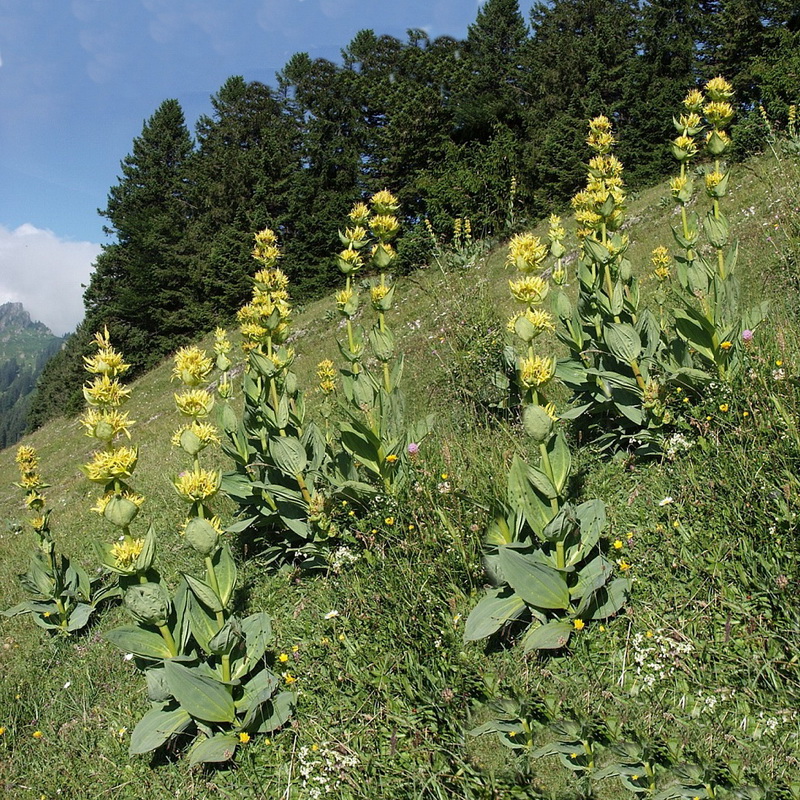
BILJNI PREPARATI LINCURE:
TINKTURA, LINCURA HSS hidroetanolni tečni ekstrakt sušenog korena biljke, DER 1:5,
MATIČNA TINKTURA, LINCURA TM hidroetanolni tečni ekstrakt svežeg korena biljke, DER 1:2.
PREPARATI OD LINCURE
U medicini lincura se koristi za: insuficijenciju jetre, intelektualnu premorenost i opšti umor, za poboljšanje apetita, kod dispepsije, gastro-intestinalnih problema, anemičnosti, tuberkuloze, dijareje (proliva), dizenterije i kod parazita u crevima.
Lincura je jedan od najboljih ojačivača ljudskog imunog sisteama.
Stimuliše jetru, žučnu kesicu i gastrointestinalni sistem.
Sredstvo je protiv groznice.
Deluje antiinflamatorno, antiseptično, antiparazitno.
U narodnoj medicini se koristi kod komplikacija i bolesti jetre, loše probave, stomačnih infekcija, i anoreksije.
Preporučuje se za malokrvnost pošto pomaže stvaranje bele i crvene krvnie loze.
Lekoviti sastojci lincure
Kao lekoviti deo lincure se sakuplja i koristi koren. Sadrži glikozidne gorke materije, malo alkaloida gentianina, tanine, pektine, šećere, masno ulje i boju gentizin koja sprečava razvoj mikroorganizama.
Lincura se koristi se za poboljšanje apetita, bolje lučenje žuči i varenje hrane. Najčešće se upotrebljava kao sredstvo za jačanje (glavni sastojak raznih tonika), za stomak, protiv groznice, posipanje i bezbolno proširivanje rana, koren se kuva i pije protiv kašlja. Doprinosi poboljšanju sastava krvi i povećanju crvenih i belih krvnih zrnaca pa se zbog toga koristi u lečenju malokrvnosti i bledila. Preporučuje se kod nedovoljnog stvaranja želučanog soka, slabog pražnjenja želuca, kiselog podrigivanja i gorušice, kod hronične začepljenosti, groznice, teškog disanja i astme.
Pre svega, treba znati da se preparati od lincure smeju piti samo pre jela, a nikako za vreme ili posle obroka. Gorki sastojci lincure pojačavaju lučenje želudačnog soka, čime lincura olakšava i ubrzava varenje. Koren se najčešće stavlja u rakiju, a u apotekama se pravi ekstrakt od lincure.
Properties and Uses: A powerful tonic, excites the appetite, invigorates digestion, and moderately increases the circulation and temperature of the body. Used in cases of debility and exhaustion, and in all cases where a tonic is required, as dyspepsia, gout, amenorrhea, hysteria, scrofula, intermittents, diarrhea, worms, etc. Dose of the powder, from ten to thirty grains; of the extract, from one to ten grains; of infusion, one or two fluidounces ; of tincture, one or two fluidrachms. When taken in large doses, it is apt to oppress the stomach, irritate the bowels, and even produce nausea and vomiting. Its administration is contra-indicated where gastric irritability is present.
Dr. Kuchenmeister believes that impure and uncrystallized gentianin is the most valuable substitute for quinia, acting as rapidly, and as efficaciously on the spleen, in doses of from fifteen to thirty grains twice a day.
Warning Gentian should be taken in small doses and Never by pregnant women.
BILJNI PREPARATI LINCURE: Gentiana lutea L.
TINKTURA, LINCURA HSS hidroetanolni tečni ekstrakt sušenog korena biljke, DER 1:5,
MATIČNA TINKTURA, LINCURA TM hidroetanolni tečni ekstrakt svežeg korena samonikle biljke, DER 1:2.
Gentianae tinctura (PhEur), DER 1:5,
Gentianae radicis recentis extractum ethanolicum liquidum DER 1:2.
ATC: najbolji amarum tonicum
U skladu sa:
Based on Article 10a of Directive 2001/83/EC as amended (well-established use),
Based on Article 16d(1), Article 16f and Article 16h of Directive 2001/83/EC as amended (traditional use), DIRECTIVE 2004/24/EC OF THE EUROPEAN PARLIAMENT AND OF THE COUNCIL of 31 March 2004.
Eu. Ph. 2015 monografijom: 0392 Gentianae radix,
EMA/HMPC/578324/2008, Committee on Herbal Medicinal Products (HMPC) od 12.11.2009.: Community herbal monograph on Gentiana lutea, radix
EMA/HMPC/578322/2008, Committee on Herbal Medicinal Products (HMPC) od 12.11.2009.: Assessment report on Gentiana lutea, radix
Fr. Ph. 1989 ANSM, Pharmacopée française 1989 (French Pharmacopoeia 1989):
Gentiana lutea pour préparations homéopathiques Gentiana lutea ad praeparationes homoeopathicas.
B.P.C. Tinctura Gentianae – TINCTURE OF GENTIAN. (The British Pharmaceutical Codex, 1911, was published by direction of the Council of the Pharmaceutical Society of Great Britain.)
Koren lincure je oficijelan prema farmakopeji bivše Jugoslavije. Upotrebljava se: Radix gentianae.
Oficijelna je prema: B.P.C (1934), Brit. Herb.Pharm (1983).
„The root of Gentiana lutea, Linné.“—(U. S. P).
Nemačka Komisija E: The Complete German Comission E Monographs, 1988. Američko izdanje, str. 232.
Biljni preparati u tečnom obliku (nerazblaženi ili razblaženi) za oralnu i lokalnu upotrebu.
a) Gentiana lutea, radix (Gentian, great yellow gentian fresh, underground part of plant).
Sastav:
a) tečni ekstrat (DER 1:2), ekstrakcioni rastvarač etanol 65% (v/v),
Gentiana lutea L., sadrži 76 istraženih bioaktivnih hemijskih jedinjenja koja ispoljavaju 501 dejstvo (*podaci ažurirani oktobra 2016.).
Sadržaj:
a) minimalno xxxxxx0,05% m/m ukupnih ) u obliku heterozida (MF: C16H18O9, MW: ,3 g/mol−1),xxxxx
b) u većoj koncentraciji sadrži alkaloide gentiananine, gentianadine, gentianamine, kalaj, limonen,
Gentiamarin, gentiin, gentisin, mesogentioigenin, protogentiogenin, sugar and xanthone pigment. bitter glycosides, alkaloids, flavonoids
Chemical Composition.—The following three proximate principles are the characteristic constituents of gentian root: Gentiopikrin, of Kromayer (1862), to which the root owes its bitterness;
gentisin, of Hlasiwetz and Habermann (1875), a yellow, tasteless substance, whose reactions with ferric chloride seem to have been mistaken for those of tannin (see Maisch, Amer. Jour. Pharm., 1876, p. 486, and 1880, p. 1);
and gentianose, of Arthur Meyer (1882), a crystallizable, fermentable sugar, not reducing Fehling’s solution, and which occurs in the fresh root only.
The root also contains a volatile oil to which its odor is due; fatty and resinous matter, uncrystallizable sugar, large quantities of mucilage, about 8 per cent of ash, but no starch. Drying the root seems to have the effect of increasing the resinous matter (Flückiger, Pharmacognosie, 1891).
GENTIOPIKRIN (C20H30O12), first obtained pure by Kromayer (Arch. der Pharm., 1862, Vol. CLX, p. 27), was previously described as gentianin by Henry and Caventou (1821), and later differentiated by Trommsdorff, Leconte, and Dulk into the bitter gentianin and the non-bitter acid gentisin or gentisic acid.
Gentiopikrin is completely abstracted from aqueous solution by animal charcoal; on this principle its purification was affected. It crystallizes in needles of bitter taste, soluble in water and alcohol, insoluble in pure ether. It is a glucosid, being decomposed by diluted acids into sugar and amorphous, yellow-brown, bitter gentiogenin (C14H16O5.. Kromayer obtained from 6 pounds of fresh root only 4 grammes of crystallized gentiopikrin. Ɣ Flückinger (1891) records that alcoholic tinctures of gentian root lose their bitterness upon standing, crystallized dextrose being deposited (Crawfurd and Wittstein). Alkali likewise destroys the bitterness of the tincture.
GENTISIN (C14H10O5., of Hlasiwetz and Habermann (Jahresb. der Pharm., 1874, p. 309), forms yellow, tasteless needles, nearly insoluble in water and ether, crystallizable from alcohol. The researches of Kostanecki and his pupils (Ber. d. Deutsch. Chem. Ges. Ref., 1891 and 1894) have shown that this substance is a trioxyxanthone belonging to the same class of substances as chrysin, quercetin, fisetin, and other vegetable dyes. Fusing with caustic potash splits gentisin into acetic acid, phloroglucin, and oxysalicylic acid (C9H6O4), an isomer of protocatechuic acid, it was probably the gentisic or gentianic acid of older authors. In 1894, Kostanecki and Tambor succeeded in effecting the complete chemical synthesis of gentisin (which is methyl-gentiseïn, Kostanecki, 1891); gentiseïn (C13H8O5.+ H2O) being the intermediary product (Ber. d, Deutsch. Chem. Ges. Ref., 1894, p. 190). G.W. Kennedy (Amer. Jour. Pharm., 1881, p. 280), found gentiopikrin and gentisin also in the root of Frasera Walteri (which see).
c) više od svih biljaka sadrži C8H7NO2 Gentianadine, Gentianine,
d) koren sadrži 78% vode
Indikacije: Biljni preparati su namenjeni poboljšanju opšteg stanja organizma kroz razna naučno dokazana dejstva.
Upotreba kod gastrointestinalnih tegoba, slabog apetita, slabog želuca, nadutosti, upotrebljava se kao aperitiv, stomahik, stimulant i tonik, za jačanje krvi, stomaka (pojačava sekreciju želudalnih sokova), kod karcinoma.
Medicinal Properties: Stomachic, bitter tonic, anthelmintic, antibilious, cholagogue, febrifuge, refrigerant, alterative, antibacterial, antipyretic, stimulant, anti-inflammatory, laxative
Dr. Džems Djuk (Dr. James Duke) u Handbook of Medicinal Herbs, 2nd Ed. (2002). CRC Press, navodi sledeće:
– ima jako dejstvo kod: dispetičnih tegoba, anoreksije, nadimanja,
Uses: An excellent and reliable tonic and blood purifier. Good for liver complaints and dysentery. Most effective for jaundice, hepatitis, enlargement of liver and spleen, and rheumatism. Prevents cramps and convulsions. Excellent for the liver and spleen. Gentian root will improve the appetite and strengthen the digestive organs. Good for gastritis, indigestion (its most common use is as a digestive bitter with alcohol), heart burn, and stomach aches. When used for these conditions, gentian should be taken 30-60 minutes before meals. Increases circulation, benefits the female organs, and invigorates the entire system. Useful in fevers, colds, gout, scrofula, and acne, rashes, obesity, ulcers, some cancers, diabetes. Expels worms. Excellent in suppressed menstruation and scanty urine. Because of its bitterness, it is better to combine gentian root with some aromatic herb such as a small amount of licorice. It is more effective than quinine. Allays poison from insect and snake bites. Yellow gentian is useful as a blood-builder during convalescence, since it raises the white blood cell count. Kills plasmodia (organisms that cause malaria) and worms.
Used externally as a wash for wounds and inflammations; also fresh leaves placed on open wounds and inflammations act as a refrigerant; and they are soothing as footbaths. Native Americans also applied an infusion of blue gentian root to relieve backache. Chinese use one of their species for pelvic inflammatory disease, genital herpes, venereal sores, and venereal diseases.
The root is the part used for internal treatment. For external use prepare a tincture from the root and flowers. (The dye derived from coal tar is called Gentian Violet. It is a widely used stain in histology, cytology and bacteriology. Used therapeutically as a topical anti-infective. Its chemical name is hexamethylpararosaniline. Has nothing at all to do with the gentian plant).
Efikasan protiv herbpathy
Henriette’s Herbal Homepage Henriette’s Herbal Homepage
– delotvoran kod: Achlorhydria Arthrosis Edema Enterosis Fever Gastrosis Gastroenterosis Heartburn Inflammation Pain Stomachache Typhus Ulcer Vomiting Wound
Action, Medical Uses, and Dosage. A powerful tonic, improves the appetite, strengthens digestion, gives more force to the circulation, and slightly elevates the heat of the body. When taken in large doses it is apt to oppress the stomach, irritate the bowels, and even produces nausea and vomiting, as well as fullness of pulse and headache. Its administration is contraindicated where gastric irritability or inflammation are present. Used in cases of debility and exhaustion, and in all cases where a tonic is required, as dyspepsia, gout, amenorrhoea, hysteria, scrofula, intermittents, diarrhoea, worms, etc. A tincture made by percolation of 1 part of podophyllum and 5 parts of gentian, diluted alcohol being the menstruum, was prized by Prof. Scudder as one of the most efficient remedies for „atony of the stomach and bowels with feeble or slow digestion“ (Spec. Med.). Gentian is valuable to relieve irritation and increase the appetite, after protracted fevers, where the powers of life are depressed and recovery depends upon ability to assimilate food. +
Dose of the extract, from 1 to 10 grains; of infusion, 1 or 2 fluid ounces; of tincture, 1 or 2 fluid drachms; of specific gentiana, 5 to 40 drops.
Dr. Küchenmeister believes that impure and uncrystallized gentianin (see previous editions of the Amer. Disp.) is the most valuable substitute for quinine, acting as rapidly and as efficaciously on the spleen, in doses of from 15 to 30 grains twice a day.
Specific Indications and Uses: „Sense of depression referred to epigastric region, and associated with sense of physical and mental weariness“ (Scudder, List of Specific Indications).
– u narodnoj medicini kod: anemia Bite Bronchosis Atony Cancer Cancer, liver Cancer, spleen Carcinoma Cardiopathy Chlorosis Cholecystosis Cold Convulsion debility diarrhea dysmenorrhea dysuria Gout Headache Hepatosis Herpes Hyperemia Hysteria Induration Jaundice Malaria Nausea Neurosis Nicotinism Rheumatism Snakebite Sore Sore Throat Splenosis Syncope Worm
– spoljašnja primena kod:
– upotrebljava se kao: stimulator želudačne i crevne sekrecije, kao jak Bitter Roborant Secretagogue Sialagogue, zatim analgesic, antiemetic, antiinflammatory antipyretic aperitif astringent holagog holeretik CNS stimulant digestive Fungistat gastrostimulant, Insecticide, Mutagenic, u tradicionalnoj narodnoj medicini kao Antiseptic Carminative Depurative Emmenagogue stimulant stomahik, Vermifuge,
– redosled dejstva po broju aktivnih bioaktivnih hemijskih jedinjenja: antibacterial, antioxidant, antiinflammatory, Cancer-preventive, antispasmodic, analgesic, antiseptic, immunostimulant, antiviral, antidiabetic, hypocholesterolemic,
Doziranje i način primene:
1 mL (40 kapi) podeljeno u 2 do 4 doze.( 20–40 drops tincture – Peirce1999; 10 drops tincture 2-3 ×day Madaus1976; up to 20 drops tincture -Lininger et al.1998.)
Biljni preparat LINCURA HSS i TM:
pojedinačna doza: 0,25-0,5 mL, preporučena dnevna doza (PDD): 1 mL.
Oralna (15 do 30 minuta pre obroka) i lokalna primena.
Upotreba na koži: aplicirati na obolelo mesto u tankom sloju ili obliku impregniranog zavoja.
Napraviti pauzu posle 4 nedelje neprekidne upotrebe. NA KORISTITI DUŽE OD 4 NEDELJE U KONTINUITETU.
Po preporukama, preparat postiže najbolje efekte pri upotrebi od 8 do 12 nedelja, duža upotreba je bezbedna uz pauze.
Kontraindikacije: upotreba kod kiseline u stomaku, gastritisa, gorušice, čira na želucu i dvanaestopalačnom crevu.
preosetljivost na aktivne supstance, preosetljivost na biljke porodice (genus Gentiana, family Gentianaceae).
Izbegavati ako želite da ostanete trudni, izbegavati tokom trudnoće i dojenja. Ne prekoračivati preporučenu dnevnu dozu.
Kontraindikacije, interakcije, sporedni efekti: klasa 2d. Može izazvati glavobolju. Navodno kontraindikovana kod hipertenzije, dokumentovana je mutagena aktivnost (gentisin i isogentisin), utiče na menstrualni ciklus. Kod osetljivih osoba može izazvati hiperaciditet. Prevelike doze mogu izazvati želudačnu iritaciju, što rezultira mučninom i povraćanjem.
UPOZORENJE: lincuru ne smeju koristiti trudnice, osobe s povišenim krvnim pritiskom i osetljivim želucem, osobe s povećanom sekrecijom želudačne kiseline i osobe sa sklonošću krvarenjima (nos ili unutrašnji organi). Ako se upotrebljava posle jela može otežati varenje hrane.
Čuvanje: na tamnom, suvom i hladnom mestu do 20˚C, van domašaja dece i izlaganja EM zračenju, u dobro zatvorenoj originalnoj ambalaži.
Rok upotrebe: 5 godina, posle prvog otvaranja 6 meseci.
Pakovanje: 50 mL i 100 mL, standardne farmaceutske braon bočice; 250 mL, 500 mL, 1L i 5 L na zahtev.
Nutritivne informacije:
LINCURA HSS i TM:
a) energetska vrednost u 100 mL: 1504 kJ/ 360 kcal,
u preporučenoj dnevnoj dozi (PDD) 1 mL: 15kJ/ 3,6kcal,
suve materije (DR) više od 2,5% (Fr. Ph.).
Bez konzervanasa, proteina, masti i ugljenih hidrata.
LINCURA HSS i TM su rukom rađeni proizvodi.
TINKTURA, LINCURA HSS, 50 mL/ 600,00; 100 mL/ 1200,00 hidroetanolni tečni ekstrakt sušenog korena samonikle biljke, DER 1:5,
MATIČNA TINKTURA, LINCURA TM, 50 mL/ 750,00; 100 mL/ 1500,00, hidroetanolni tečni ekstrakt korena sveže samonikle biljke, DER 1:2.
Podaci ažurirani oktobra 2016.
Poželjno pogledati i ostale informacije na:
http://www.biljni-preparati.com/preparati/
Gentiana lutea (Gentianaceae) Common name: Gentian; Yellow Gentian; How used: Medicinal;
Activity:
pesticide, antibacterial, antioxidant, antiinflammatory, Cancer-preventive, antispasmodic, analgesic, antiseptic, immunostimulant, antiviral, antidiabetic, hypocholesterolemic, antiarthritic, antimutagenic, antirheumatic, antiradicular, hypoglycemic, hypotensive, cardioprotective, fungicide, antiedemic, hepatoprotective, allergenic, antiosteoporotic, anxiolytic, anticataract, antiacne, antiobesity, antitumor, antidepressant, antiatherosclerotic, sedative, antisyndrome-X, antihepatotoxic, immunomodulator, antiasthmatic, diuretic, antiulcer, antifatigue, vulnerary, antihistaminic, choleretic, vasodilator, anticancer, antihypertensive, antilithic, antiherpetic, antiLyme, chemopreventive, antimigraine, antiaggregant, antidementia, antiarrhythmic, antistaphylococcic, nematicide, antiepileptic, ornithine-decarboxylase-inhibitor, expectorant, antiproliferant, antihangover, prooxidant, antialzheimeran, antiaging, antimenopausal, antiHIV, antimaculitic, anticlimacteric, antiPMS, antiperoxidant, antileukemic, antialcoholic, antifibrotic, flavor, antistress, antitumor (prostate), antimigraine, antiaggregant, antidementia, antitumor (colon), …
Reference:
Chalchat, J.C. et Garry, R.P.*, Bastide, P., Fabre, F. et Malhuret, R. Correlation Composition Chimique/Activite Antimicrobienne: V – Contribution a la Comparaison de 2 Methodes de Determination Des Cmi. Plantes medicinales et phytotherapie, 25: 184-193.
Wagner & Wolff, eds. 1977. New Natural Products (RS164. I56. 176)
HerbalGram No. 22 – Spring 1990, page 14.
Ortiz de Urbina, J.J., Martin, M.L., Sevilla, M.A., Montero, M.J., Carron, R., and San Roman, L. Antispasmodic Activity on Rat Smooth Muscle of Polyphenol Compounds Caffeic and Protocathechic Acids. Phytotherapy Research 4(2): 73, 1990.
Economic & Medicinal Plant Research, 6: 189.
Jeffery B. Harborne and H. Baxter, eds. 1983. Phytochemical Dictionary. A Handbook of Bioactive Compounds from Plants. Taylor & Frost, London. 791 pp.
Acta Botanica Sinica, 32: 49.
Davies, S., and Stewart, A. 1990. Nutritional Medicine. Avon Books, New York. 509pp.
Challem, J., Berkson, Burt, and Smith, Melissa Dianne. 2000. Syndrome X – The complete nutritional program to prevent and reservse insulin resistance. John Wiley & Sons, New York. 272 pp. $24.95
Advance in Chinese Medicinal Materials Research. 1985. Eds. H. M. Chang, H. W. Yeung, W. -W. Tso and A. Koo. World Scientific Publishing Co., Philadelphia Pa., page 210.
Pizzorno, J.E. and Murray, M.T. 1985. A Textbook of Natural Medicine. John Bastyr College Publications, Seattle, Washington
Martindale’s 28th
Werbach, M. 1993. Healing with Food. Harper Collins, New York, 443 pp.
Jacobson, M., Glossary of Plant-Derived Insect Deterrents, CRC Press, Inc., Boca Raton, FL, 213 p, 1990.
Shoyakugaku Zasshi, 44: 183.
Huang, K. C. 1993. The Pharmacology of Chinese Herbs. CRC Press, Boca Raton, FL 388 pp.
CERES Gentiana lutea Urtinktur
Therapeutic Uses, Benefits and Claims of Gentian
The bitter taste of gentian is due to bitter iridoid glycosides; primarily gentiopicroside, swertiamarin, amarogentin and gentiopicrin.
Gentian contains several alkaloids, predominantly gentian and gentialutine. Additionally it contains the constituents: xanthones, triterpenes, pectin, tannin, mucilage and sugar.
Many species of gentiana are used in a similar way across widely divergent cultures. It is found in the Indian Ayurveda herbal medicine, Traditional Chinese Medicine, as well as in European herbal pharmacopeia.
It has a long history of use as bitters, used to promote the appetite and digestion by general stimulation of the digestive juices.
Gentian, as with all bitters, is important in traditional herbal medicine as a remedy for physical and mental exhaustion.
The Herb Gentian (Gentiana lutea)
The Herb Gentian (Gentiana lutea) – Illustration
It is a traditional herbal remedy for symptoms of sluggish digestion, such as dyspepsia and flatulence.
The herb is used as a blood builder, traditionally used convalescence.
It is used as a natural herbal treatment for gaining weight, anorexia and exhaustion.
Gentian is believed to strengthen the entire system by stimulating the digestive function as well as the general circulation and the activity of many glands and organs.
The herb is used as a liver tonic and to stimulate insufficient production of gastric juices, bile and saliva. It is used to alleviate inflammations in the gall bladder.
Gentiana scabra, or lung tan in traditional Chinese medicine, has much the same uses as gentian in European herbal tradition. It is used for fevers, rheumatism, toxicity of the bowels, and general debility. It is believed to enhance memory and is used as a liver tonic.
Both gentian and stemless gentian are recognized as generally safe by the FDA, and extracts of gentian are used in a variety of anti-smoking products, cosmetics and foods.
It is traditionally used as an herbal treatment for wounds; animal studies have shown it to have a measurable anti-inflammatory and wound-healing effect.
The herb is used internally as a remedy for sore throat and arthritic inflammation.
It is used in liquors and schnapps, and is an important ingredient in Angostura bitters.
It was traditionally often used in combination with other digestive stimulants such as ginger and cardamom.
X X X X X
CONSTITUENTS.—The bitter principle is a neutral principle, gentiopicrin, C20H30O12, the yellow color is due to gentisin, C14H10O5, or gentisic acid (tasteless yellow prisms). The root also contains from 12 to 15 per cent. of glucose (gentianose), C16H66O31, but is remarkable in that it contains no starch, calcium oxalate, or tannin. Ash, not to exceed 6 per cent.
Preparation of Gentisic Acid.—The alcoholic extract is washed with water, then with ether. The residue dissolved in alcohol yields the acid on evaporation. It is in yellow, tasteless crystals, partially soluble in alcohol and ether; with ferric salts gives dark brown color.
Preparation of Gentiopicrin.—Obtained by making aqueous solution of alcoholic extract. This solution is subjected to the absorptive action of charcoal. Charcoal is then boiled with alcohol, tincture evaporated, and treated with lead oxide to remove color. Lead removed by H2S; solution agitated with ether. Set solution aside to crystallize. Yellowish-brown, soluble in water and dilute alcohol.
ACTION AND USES.—Simple bitter tonic, long known and very valuable. Dose: 5 to 30 gr. (0.3 to 2 Gm.).
OFFICIAL PREPARATIONS.
Fluidextractum Gentianae, Dose: 5 to 30 drops (0.3 to 2 mils) .
Extractum Gentianae 5 to 10 gr. (0.3 to 0.6 Gm.).
Tinctura Gentianae Composita (10 per cent., with orange-peel and cardamom), 1 to 2 fl. dr. (4 to 8 mils).
erfaserarfa
Koren lincure je prijavio da sadrži 1 PPT ukupno mutagena jedinjenja, od kojih 760 su gentisin i isogentisin (CAN).
The Commission E Monographs
Gentian root
Gentianae radix
Enzianwurzel
Published November 30, 1985; Revised March 13, 1990
Name of Drug: Gentianae radix, gentian root.
Composition of Drug: Gentian root consists of the dried, unfermented roots and rhizome of Gentiana lutea L. [Fam. Gentianaceae], containing a bitter value of not less than 10,000, as well as its preparations in effective dosage.
The drug contains bitter principles (amarogentin, gentiopicroside) and the bitter-tasting gentiobiose.
Uses: Digestive disorders, such as loss of appetite, fullness, flatulence.
Contraindications: Gastric and duodenal peptic ulcers.
Side Effects: Especially sensitive persons may occasionally experience headaches.
Interactions with Other Drugs: None known.
Dosage: Unless otherwise prescribed
Daily dosage: Tincture (according to Erg. B. 6 ): 1 – 3 g;
Fluidextract (according to Erg. B. 6 ): 2 – 4 g;
Root: 2 – 4 g.
Mode of Administration: Comminuted drug and dried extracts for infusions, bitter-tasting forms of medications for oral administration.
Actions: The essential active principles are the bitter substances contained in the herb. These bring about a reflex excitation of the taste receptors, leading to increased secretion of saliva and the digestive juices. Gentian root is therefore considered to be not simply a pure bitter, but also a roborant and tonic.
In animal experimentation there are indications that bronchial secretion is increased.
Монографије Е Комисије
Корен Линцуре
Gentianae radix
Enzianwurzel
Објављено 30. новембра 1985 .; Преправљено 13. марта 1990
Назив лека: Gentianae radix, radix Gentianae.
Састав лека: Корен Генцијане састоји се од осушених, неферментираних корена и корена Гентиана лутеа Л. [Фам. Гентианацеае, која садржи горку вредност не мању од 10.000, као и њени препарати у ефикасној дози.
Лек садржи: горке принципе (амарогентин, гентиопицросиде) и гентиобиозу горког укуса.
Употреба: Пробавни поремећаји, попут губитка апетита, пуноће, надимања.
Контраиндикације: Пептични чир на желуцу и дванаестопалачном цреву.
Нуспојаве: Посебно осетљиве особе повремено могу имати главобоље.
Интеракције са другим лековима: Није познато.
Дозирање: Уколико није другачије прописано:
Дневна доза: Тинктура (према Ерг. Б. 6): 1 – 3 г;
Флуидекстракт (према Ерг. Б. 6): 2 – 4 г;
Корен: 2 – 4 г.
Начин примене: дробљени и сушени екстракти за инфузије, лекови горког укуса за орално давање.
Деловање: Основни активни принципи су горке материје садржане у биљци. Они изазивају рефлексно побуђивање рецептора укуса, што доводи до повећаног излучивања пљувачке и пробавних сокова. Сматра се да корен Корен Линцуре није само чиста горчина, већ и роборант и тоник.
У експериментима на животињама постоје индикације да изазива повећану бронхијалну секрецију.
Gentian root (Gentianae radix)
Published November 30, 1985; Revised March 13, 1990.
List of German Commission E Monographs (Phytotherapy)
Gentiana lutea Bundesanzeiger Nr. 217a vom 22.11.1985
Monographie BGA/BfArM (Kommission D)
Gentiana lutea Gelbenzian
Gentiana lutea Bildtafeln und Monographien
Gentiana lutea Die Phytotherapeutische Welt (1983)